
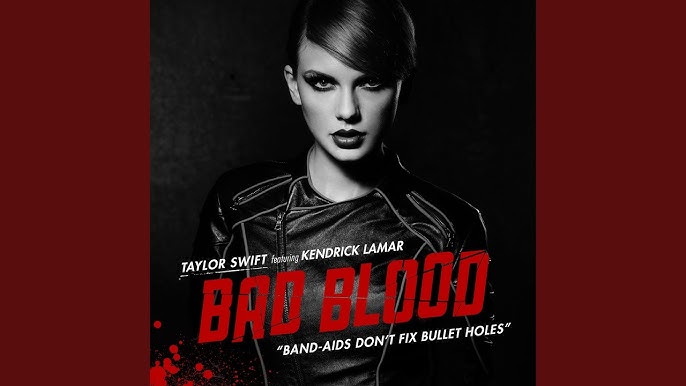
“‘Bad Blood’ is a song I wrote about a new kind of heartbreak that I experienced recently which was when someone that I desperately wanted to be my friend and thought was my friend ended up making it really obvious that she wasn’t, so…this was someone I really looked up to and I really, really longed for the approval of this person, and so it was kind of devastating to receive kind of a low-blow from that person. And, this song was kind of the first time I ever stood up for myself in that relationship, because she was always the bolder one and the louder one. I think it’s important to stand up for yourself and if you can only really come up with the courage to do it in song form than that’s how you should do it.”
— Taylor Swift, Big Machine Radio Release Special Commentary
“She made friends and enemies.”
— Hidden message in liner notes
Well, here we go…
Ever since I started this journey through Taylor Swift’s songbook last August, all of the songs I have written about I have been highly positive on. Obviously, as a hardcore Swiftie, I am highly positive on the vast, vast majority of her songs. Even songs that I will be writing about in the future, such as “Girl at Home” and “ME!” that people almost universally regard as lower-tier Taylor songs, are ones I still can get on board with when I am in the right mood due to their sincere goofiness.
However, there are three particular songs in Taylor’s discography that I actively dislike, and one of those three is the song I am writing about for this week on The Manuscript. While I would not say that “Bad Blood” is the worst song that Taylor has ever released (although others, including Rolling Stone’s resident Swiftie Rob Sheffield, have made that exact argument), it is certainly one of her three worst songs in my opinion.
Rather than tapping into the sincere goofiness of her best pure pop songs, “Bad Blood” instead basks in anger and petty vindictiveness in a significantly worse way than she had both previously on Speak Now’s “Better Than Revenge” and would later do on several Reputation tracks. And in comparison to “Shake It Off,” the other 1989 number-one single clearly influenced by Gwen Stefani’s “Hollaback Girl,” “Bad Blood” has just always struck me as a soulless Max Martin/Shellback production, one that strips away most of what makes Taylor such a singularly special pop music artist and turns it into a piece of product that could just as easily be sung by Britney Spears or Miley Cyrus or even Gwen Stefani herself. And above all, the lyrics of “Bad Blood” are ones where Max Martin’s voice shines through way more than Taylor’s, lacking her beautiful, specific, poetic touch in favor of generic, bargain-basement sixth-grade-level writing.
But, as per usual, I am going to break down and analyze this song as I intend to do with all of her songs. But here, unlike the ones I have written about previously, everything in “Bad Blood” is fully on the surface. The only deeper meaning present in this song is the subtext regarding the falling out between her and Katy Perry, which Taylor first alluded to without naming names in a Rolling Stone cover story published at the beginning of the 1989 album rollout. This subtext does make the song substantially more interesting than it is just at face value, and certainly provides the overwhelming majority of fodder for lyrical analysis of not-great lyrics, starting from the chorus that opens the song:
‘Cause, baby, now we got bad blood
You know it used to be mad love
So take a look what you’ve done
‘Cause, baby, now we got bad blood, hey
Now we got problems
And I don’t think we can solve ‘em
You made a really deep cut
And, baby, now we got bad blood, hey
It does not exactly take a genius to figure out that this song is about some sort of lost love, whether a lost romantic love or friendship love. But what I think is most noteworthy here, particularly when examining the song through the lens of Taylor’s history with Katy Perry, is the acknowledgment of Taylor’s history with Katy Perry before their falling out, which she pretty simplistically refers to here as “mad love” (a byproduct of Max Martin’s torturing language than anything else). Even going by Taylor’s own words in the aforementioned Rolling Stone cover story, she was “never sure if we were friends or not” for years leading up to their falling out. More specifically, Taylor said that Katy Perry “would come up to me at awards shows and say something and walk away, and I would think, ‘Are we friends, or did she just give me the harshest insult of my life?’”
That being said, there is evidence that, at least publicly at these awards shows, the two of them gave off vibes that could be described as “mad love”. A video from the 2008 MTV Video Music Awards shows Taylor interviewing both Katy and Miley Cyrus while working the red carpet, referring to them both as “beautiful ladies,” that they were all “crazy about each other,” and the three of them being nominated for the Best New Artist VMA is not awkward because they all love each other. Hearing Taylor explicitly say “I love Katy Perry” and Katy then saying “We love Taylor Swift” in unison with Miley is a strong testament to the public front they all put on for their fans and the tabloid celebrity media, even if Taylor is correct in stating that her relationship with Katy was more complicated than either of them ever let on at that time.
Regarding the unsolvable problems and “deep cut” that Taylor refers to in the second part of the chorus, Taylor said in that same Rolling Stone cover story that it “had to do with business,” even pointedly declaring that “it wasn’t even about a guy” to preemptively shut down any speculation that this was a repeat of her feud with Camilla Belle over Joe Jonas that inspired “Better Than Revenge” (although, notably, Katy Perry did date John Mayer at one point during her feud with Taylor). As to the “business” that instigated their falling out, Taylor said that Katy “basically tried to sabotage an entire arena tour. She tried to hire a bunch of people out from under me.”
This quote was all the Swifties needed to figure out, as Tom Breihan stated in his own piece about “Bad Blood” that he wrote last year, “that three backup dancers did indeed leave [Taylor]’s employ to work for Katy Perry.” And if there is one thing that Taylor takes deadly seriously, it is her tour operation. I saw the Red Tour in 2013, the tour that Katy had “tried to sabotage,” at Soldier Field and it was unlike anything I had ever seen up to that point. It was a production. So yes, of course Taylor would be greatly upset at any attempt to sabotage it.
As the song goes into its first verse, the lyrics’ lack of specificity and repeating of the same general idea continue:
Did you have to do this?
I was thinking that you could be trusted
Did you have to ruin
What was shiny? Now it’s all rusted
Did you have to hit me
Where I’m weak? Baby, I couldn’t breathe
And rub it in so deep?
Salt in the wound like you’re laughin’ right at me
Oh, it’s so sad to think about the good times, you and I
Once again, these lyrics are not Taylor at her deepest or most enlightened at all. In fact, I would go as far as to say that they add absolutely nothing new to the song’s meaning or significance. The most significant lyric here for me is “I was thinking that you could be trusted,” which does speak to Taylor’s quote at the top of this post where she talked about looking up to Katy Perry and desperately wanting to be her friend. But other than that, the thing that strikes me about this verse (and the second verse as well) is how effectively Taylor sings it, especially on the original recording when her anger at Katy was a lot fresher. You can tell how pissed she was, and that vocal delivery does help to sell the generic elementary-school-level lyrics better than anybody else probably could have.
And then just before the song transitions back into the chorus, Taylor’s voice goes up significantly as she reflects on how sad it is to think about the times when she thought Katy was her friend and wanted to be friends with her, a part that significantly stayed on the Kendrick Lamar remix of this song that will be discussed later on in this post.
After another recitation of the chorus where Max Martin and Shellback’s production becomes louder and more audible, Taylor delivers another generic chorus harping on the same themes:
Did you think we’d be fine?
Still got scars on my back from your knife
So don’t think it’s in the past
These kind of wounds, they last and they last
Now, did you think it all through?
All these things will catch up to you
And time can heal but this won’t
So if you’re coming my way, just don’t
Oh, it’s so sad to think about the good times, you and I
While the first verse was mostly asking Katy Perry confrontational questions about the motivation for her transgressions, this verse, while asking two more of those questions, is more confrontational in how it addresses Katy’s supposed desire to move on and forgive and forget. But as Taylor makes clear here, this is not something she intends to move on from anytime soon and she has no desire to rekindle their friendship. But perhaps the most cutting lyrics in this verse (and arguably in the whole song) are Taylor telling Katy Perry that all of the things that she did will catch up to her, which can be seen as an acknowledgment of both the song being released more than a year after Katy’s actions and the hit Katy would take among the Swifties following the song’s release.
And indeed, while Katy did have one more top 10 hit song after 2014 (“Chained to the Rhythm”) and a few more top 10 albums, her six-year run of nonstop hits from 2008’s “I Kissed a Girl” to 2014’s “Dark Horse” basically ended right around the time that Taylor’s feud with her went public. Granted, I am not saying that their feud was the reason for Katy’s fall from the top of the pop music world (Tom Breihan has suggested the end of her collaboration with producer Dr. Luke as the primary reason), but backlash from Swifties who were also fans of Katy could definitely be seen as one of the reasons.
After another recitation of the chorus, the Max Martin/Shellback production drops out, and Taylor’s voice breaks through ominously as the bridge starts:
Band-Aids don’t fix bullet holes
You say sorry just for show
If you live like that, you live with ghosts
Band-Aids don’t fix bullet holes
You say sorry just for show
If you live like that, you live with ghosts, mmm
If you love like that, blood runs cold
Shortly before the song’s conclusion, Taylor once again addresses Katy’s supposed desire to move on from their feud, accusing her of offering an insincere apology and not acknowledging the severity of her wrongdoing. But then, in two even more pointed lines, Taylor offers cold advice to Katy about continued consequences to living her life in the way that she has conducted herself in relation to Taylor. First, she says living like this will result in more lost friendships that will haunt her like ghosts throughout her life (some have even interpreted the use of “ghosts” in this lyric as a reference to Katy’s then-recently released album track “Ghost”). Then, in the bridge’s final lyric that Taylor belts out in one of her best vocal deliveries on this song, she says that conducting any sort of love in the manner that she has conducted her relations with Taylor will result in heartbreak or spilled blood running cold, meaning that it will ultimately not turn out well for her however it ends.
The song then reaches its production climax through the last two recitations of its chorus, in many ways representing Max Martin and Shellback at their most bombastic, concluding with the production dropping out except for the drum machine at the end as Taylor recites the title line one last time culminating with a reverbed “Hey!” as the song ends on the same angry, resentful note that it started on.
______________________________________________________________________________
Mostly thanks to Taylor’s quotes from the Rolling Stone cover story mentioned above, as well as that article’s writer Josh Eells’ disclosure of Taylor’s quotes referring to the inspiration for “Bad Blood,” the song got a ton of press nearly two months before any member of the general public had even heard it. Literally hours after the Rolling Stone article went to press, Katy Perry took to Twitter and simply stated “Watch out for the Regina George in sheep’s clothing…” This was seen by many as an acknowledgment that the song was, in fact, about her, which greatly increased anticipation in advance of the song’s release.
However, once the song was finally released as a 1989 album track in October 2014, it only reached #78 on the Billboard Hot 100, as the two songs being promoted as singles that fall (“Shake It Off” and “Blank Space,” both vastly superior to “Bad Blood”) took turns in the number-one spot. However, once the spring of 2015 and 1989’s third single “Style” only managed a peak of number six (unfortunately, since that is such a great song), Taylor and her team began pulling out all of the stops on behalf of “Bad Blood”.
Paparazzi spotted Taylor filming the “Bad Blood” music video that April, and Taylor soon began a 10-day countdown on social media for the music video’s premiere as part of the Billboard Music Awards. To say anticipation for this was extremely high for this video would be a massive understatement. While it was known that some of Taylor’s best friends (dubbed her “Squad” by the tabloid press) were in it, and that it was being done on a massive budget, the sheer blockbuster-level production values and number of famous women present in the video still threw several people (including me) for a loop. Ten years later, this video is still tremendous, a much better video than the song deserves and a fantastic pastiche of Hollywood sci-fi/action blockbusters.
However, the biggest surprise was still not the production values or famous women, but that the video was also used to launch a surprise remix of the song featuring none other than Kendrick Lamar. Now, full disclosure: while I highly respect and appreciate Kendrick as an artist and songwriter and the impact his work has had on pop culture, I would not call myself a fan of his music. I remember when this remix came out and not wanting to listen to it due to my general dislike of rap music and dismissed the excising of Taylor’s verses in favor of Kendrick’s rapping as akin to none other than Katy Perry’s half-assed remix of her song “E.T.” featuring Kanye West (bizarrely, Taylor had to shut down a rumor in 2015 that Kanye would guest on the remix of “Bad Blood,” something that seems absolutely hilarious in retrospect).
However, looking back at the Kendrick remix of “Bad Blood” now, it is clear that his verses add color and specificity to a song that pretty desperately lacked both. Even the first verse that Kendrick raps in the remix make this abundantly clear:
I can’t take it back, look where I’m at
We was OG like D.O.C., remember that?
My TLC was quite OD, ID my facts
Now POV of you and me, similar Iraq
I don’t hate you, but I hate to critique, overrate you
These beats of a dark heart, use baselines to replace you
Take time and erase you, love don’t hear no more
No, I don’t fear no more, better yet, respect ain’t quite sincere no more
While yes, there are a lot of vague word games going on here, and fans of Kendrick can probably point to several better examples of his bars, these lyrics do make the song deeper overall, particularly as he brings in subtle references to the history of celebrity feuds in the hip-hop world, in many ways foreshadowing his own hip-hop feud that would boil over nine years later.
In particular, the reference in this verse to rapper The D.O.C., and by association, his 1990s feud with Dr. Dre is fascinating and an example of how Kendrick can make his style of songwriting work in pure pop music like this. Even the reference to the Iraq War, which may have come off as tasteless by anyone else, instead reflects the emotional intensity of these feuds, particularly when they get blown up and egged on by the media (see how Kendrick’s pedophilia allegation against Drake would become something of a sub-phenomenon of their feud that’s now lasted more than a year).
And while Kendrick’s second verse is not nearly as specific, it still is wonderfully dynamic and fun, both things the original song was not:
Remember when you tried to write me off?
Remember when you thought I’d take a loss?
Don’t you remember? You thought I would need ya
Follow procedure, remember? Oh, wait, you got amnesia
It was my season for battle wounds, battle scars, body bumped
Bruised, stabbed in the back, brimstone, fire jumping through
Still, all my life, I got money and power
And you gotta live with the bad blood now
In many ways, this verse communicates the exact same thing as Taylor’s two verses on the original “Bad Blood” with much more lyrical sophistication and wit. Rather than venting general feelings about the aftermath of a falling out, Kendrick takes the listener deep into the visceral feeling of this, comparing the emotional fallout to the most painful and brutal of physical fallouts, but then coming back at the end to claim victory by basking in his money and power while the person at the other end of this falling out has to live with the “bad blood” of it. Once again, in retrospect, Kendrick rapping this seems like a decade-earlier preview of his feud with Drake, and according to Tom Breihan, several Kendrick fans do actually think his verses are about Drake, something he has never confirmed.
And then, during the bridge, in between Taylor’s two recitations of her lyrics, Kendrick gets in one more lyric that would become the most recognized of his contributions to the song:
You forgive, you forget, but you never let it go
It’s a fascinating lyric that, in exactly ten words, embodies all of the contradictions of dealing with hurt and betrayal while trying to maintain some semblance of adult maturity while facing the public as a celebrity, and once again deepens the song much more significantly than had been the case previously.
At any rate, the “Bad Blood” music video and Kendrick remix did what they needed to do to get “Bad Blood” to number one on the Billboard Hot 100, giving Taylor her fourth number one (and third from 1989) and Kendrick his first. And while the song only lasted at number one for a week (it briefly interrupted the dominant 12-week number-one run of “See You Again,” a song Taylor would perform with Wiz Khalifa in Houston on the 1989 World Tour), it quickly became a smash hit on pop radio and became one of the defining songs not only of the summer of 2015, but of that year (it placed at #15 on the year-end Hot 100).
To give you just an idea of how dominant this song was in 2015, it was parodied in a viral video to raise awareness for bone marrow donations, it was parodied by two British female comedians to critique the U.K.’s “Tampon Tax,” it was parodied by the animated web series How It Should Have Ended in the style of Batman, and some YouTuber even did a straight cover of it but in twenty different styles (including the style of Barney, which just sounds like an absolute nightmare). And of course, Jimmy Fallon being Jimmy Fallon had to do a holiday-themed parody of it as part of his end-of-the-year medley of that year’s pop hits with rewritten holiday lyrics.
But the best alternate version of this song by far was Alessia Cara’s cover of the Kendrick remix that she performed in BBC Radio 1’s Live Lounge. The combination of the stripped-down arrangement and her objectively breathtaking vocals make the song sound much more beautiful than it has any right to sound. I have no idea why the BBC Radio 1 YouTube page took down the original video, but you can watch an unofficial reposting of the video here:
While this was all going on, Taylor was, of course, on the road for the 1989 World Tour, which, along with the omnipresence of “Bad Blood,” helped make the summer of 2015 the first true “Summer of Taylor” before she came to rule the last two summers via the Eras Tour. Of course, knowing how huge “Bad Blood” was, she appropriately made it into a centerpiece of the show, complete with visuals and choreography that, if not directly mirroring the visuals and choreography from the music video, do allude to it quite a bit. Having seen this performance of the song on this tour at Soldier Field, I do remember it having a lot more life to it than the album version (and remix, for that matter), and it worked quite well.
After the 1989 World Tour, Taylor completed her 1989 victory lap by becoming the first woman to win Album of the Year twice. She then took a much-deserved break from touring, only to receive new (stupid and ridiculous) scrutiny from the press and social media trolls for her romantic life, her decision to not endorse a candidate in the 2016 presidential election, and most infamously, her very public feud with Kanye and Kim Kardashian over an edited video they used to wrongly paint her as a liar and a “snake”.
It was under this cloud that many great songs of hers (far better than “Bad Blood”) would eventually emerge, but it was also under this cloud that she performed two one-off concerts in the state of Texas. During both concerts, she gave very memorable and impassioned performances of “Bad Blood”. While her feud with Katy Perry may not have ended yet (Katy would release a song that many interpreted to be a response to “Bad Blood” called “Swish Swish” on her Prism album, and that song is borderline-unlistenable), another celebrity feud had taken center stage in her mind and many others, and watching both of these, you can tell which one is on her mind.
The first of these concerts, which took place during the Formula One United States Grand Prix in Austin in October 2016, featured a mashup that only happened once of “We Are Never Ever Getting Back Together” and “Bad Blood,” two songs that are among my least favorites in her catalog and yet, in this context, work well together. While only distant and partial audience-shot video of this performance circulates, it does capture the seamless transition between the songs:
And the second of these concerts, named the “DIRECTV Super Saturday Night” concert the day before the Super Bowl in Houston in February 2017 (known to New England Patriots fans as the “28-3” game), featured a stand-alone performance of “Bad Blood” that is notable for its lack of choreography other than Taylor’s (no backup dancers were at this show), which allows for Taylor’s emotion while singing to come through that much more. But what is also notable is that, while it may have happened sporadically throughout the 1989 World Tour, this was the earliest video I could find that showed the whole crowd singing Kendrick’s climactic lyric (“You forgive, you forget, but you never let it go”) during the bridge:
By the time Taylor was ready to go back on tour a year later following the release of Reputation, she and Katy officially ended their feud after Katy mailed her a literal olive branch and note that Taylor shared on her Instagram with the caption “Thank you Katy.” And I am not sure whether it was because of that or other factors or all of the above, but Taylor made an inspired decision regarding the performance of “Bad Blood” on the subsequent Reputation Stadium Tour. Rather than perform it straight with the bridge as she had done previously, Taylor decided to mash it up with the Debut song “Should’ve Said No,” which despite their radically different instrumental arrangements, proved to be even more of an effective mashup than what she had done in Austin in 2016. This arrangement is, to this day, my favorite version of “Bad Blood” (and I almost got to see it in-person but had to sell my tickets to that tour):
But then, of course, once the Eras Tour got underway, it was inevitable that “Bad Blood” was going to have a nightly spot in the setlist (even if my dream setlist would personally not have included it). And sure enough, it was right there every night to close out the 1989 section of the show, along with the crowd singing Kendrick’s aforementioned climactic lyric during the bridge like they had done in Houston in 2017. However, one fan tradition that no one had seen coming two months into the tour was one stemming from an incident at the third Philadelphia show of the Eras Tour on May 14, 2023.
While performing “Bad Blood” at this show, Taylor seemed to notice security guards at the base of the stage using too much force in moving fans off the barricade and rightly took issue with it, vocally defending one fan in particular from the security guard’s use of force. While singing the chorus, Taylor made a point to yell into the microphone, “She’s fine,” “She wasn’t doing anything,” and “Hey! Stop!” Once cell phone video of this incident got out, as it quickly did, it was instantly held up as an example of how much Taylor cares about her fans’ safety at her shows and drew needed attention to the unnecessary roughness of security at concerts, particularly male security’s treatment of female fans.
However, the way in which Taylor yelled at the security guard and her repeated shouts of “Hey! Stop!” became so popular among Swifties that another fan tradition was born, as during every other performance of “Bad Blood” after Philadelphia Night 3, when Taylor got to the second chorus of the song, fans would yell “She’s fine,” “She wasn’t doing anything,” and “Hey! Stop!” twice just like Taylor did at the security guard that night. This, along with the chant of Kendrick’s line, made “Bad Blood” live at the Eras Tour a joyous occasion even if you’re like me and don’t really like the song. So, as per usual, I will leave you all with the official recording of “Bad Blood” from the Eras Tour movie. The chanting of Kendrick’s line comes through great here but not the “Hey! Stop!” chant. But you can all still fill that in for yourselves.

 The Manuscript
Leave a comment