
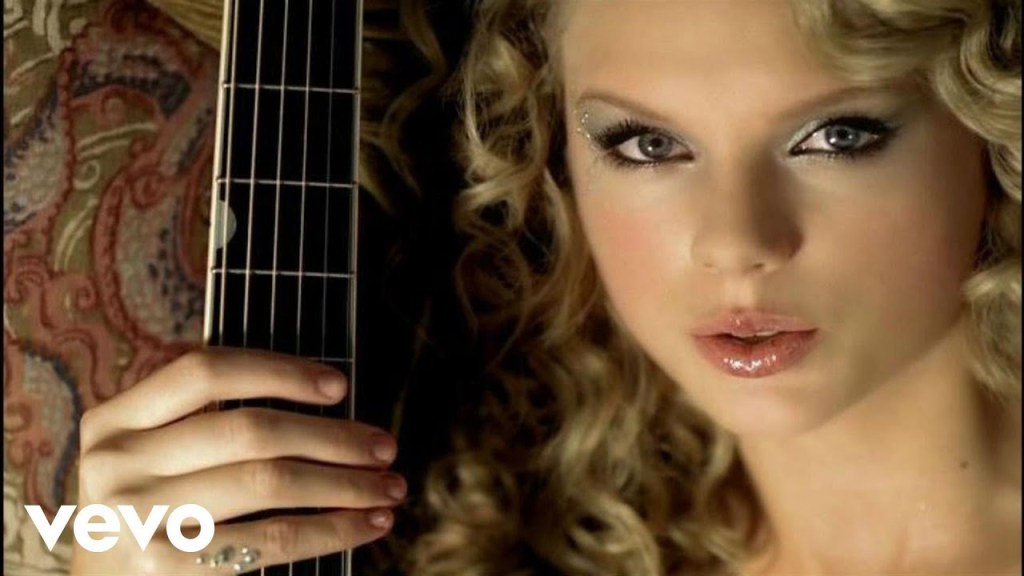
“I used to have a huge crush on this guy, who would sit there every day talking to me about… another girl: how beautiful she was, how nice and smart and perfect she was. And I sat there and listened, never meaning it any of the times I said ‘Oh, I’m so happy for you.’ I guess this is a good example of how I let my feelings out in songs, and sometimes no other way. And I’ve never been afraid of using names. I love this song because of its honesty and vulnerability. To this day, they are still together and he has no idea about this song.“
— Taylor Swift
“He will never know.”
— Hidden message in liner notes
It was February of 2008. It was shortly before my eleventh birthday, and my parents and I were planning a big eleventh birthday party at a friend’s church where we would have all of my family and friends and play games. But one of the things I was most excited about is that we were going to have a DJ. Having loved making mix CDs even at that young age, I quickly decided that I wanted to make a huge mix CD for the party that would be dominated by my two favorite bands at the time, Fall Out Boy and Panic! At the Disco (both Fall Out Boy and Panic!’s lead singer, Brendon Urie, will each make appearances on this blog at later dates). But shortly before the party happened, my good friend Sabrina, who was helping plan the party, came over and announced a song that absolutely had to be on my mix CD for the party: “Teardrops on my Guitar” by Taylor Swift.
At the time, both the song title and the name Taylor Swift were completely foreign to me. When I heard just the beginning of the song, I completely dismissed it solely based on it being country. Being neck-deep in my emo phase (see my aforementioned Fall Out Boy and Panic! At the Disco obsessions), I had been conditioned to uniformly believe that all country music sucked, and therefore I refused to give “Teardrops on my Guitar” or any of Taylor’s music from her debut album even the slightest time of day. Even as my other female friends waxed poetic about the virtues of “Teardrops,” “Tim McGraw,” “Our Song,” and “Picture to Burn,” I just plugged my ears and refused to listen. And as I stated in last week’s Manuscript entry about “White Horse,” it was not until three and a half years later that I finally set aside every ignorant reservation I had about Taylor and her music and became the die-hard Swiftie I am today.
And am I thankful as ever that I did. Listening to “Teardrops on my Guitar” now, I laugh thinking about how immature I was to dismiss it while my friend Sabrina was first playing it for me. Because it is a truly great song.
While “Tim McGraw” will forever be known as Taylor’s debut single, the song that formally introduced her to the world, for many Swifties like myself, “Teardrops on my Guitar” was the song that formally introduced her to us, because despite “Tim McGraw” being a top-10 country hit and even cracking the top 40 on the Billboard Hot 100, it received little-to-no mainstream pop radio airplay. Meanwhile, Taylor’s second single, “Teardrops on my Guitar,” not only was a #2 country hit, but it was a top-10 hit on pop and adult contemporary stations, ultimately peaking at #13 on the Hot 100. Even before “Love Story” and “You Belong with Me” launched her into superstardom, “Teardrops on my Guitar” was the first sign of everything that was to come.
And it was the perfect song to signal that, because, even more than “Tim McGraw,” “Teardrops” laid the groundwork for the beautiful, vulnerable, emotionally raw songwriting that would quickly become Taylor’s signature, literally in the first word of the song:
Drew looks at me, I fake a smile so he won’t see
That I want and I’m needing everything that we should be
I bet she’s beautiful, that girl he talks about
And she’s got everything that I have to live without
Following the understated country-inflected instrumental opening, Taylor introduces the song’s subject by name, singing it in a way that is simultaneously yearning and melancholic before describing the dynamic between the two of them that lays the foundation for the entire song: she is pining after him to the point where she cannot function, while he is completely oblivious to her feelings as he waxes poetic about his girlfriend. And while this dynamic is not exactly groundbreaking, what immediately sets it apart from other songs of a similar nature is the way in which Taylor intentionally writes the lyrics to sound like a diary entry, both in how she refrains from referring to the song’s subject in second person, instead calling him by his actual name, and the manner in which she describes her feelings in ways that may seem histrionic on the surface but in reality cut deeply in their honesty and rawness. Even her messy, contradictory line about “I want and I’m needing everything that we should be” beautifully reflects the irrationality that everybody falls into when they are hopelessly in love with someone who fails to reciprocate.
Drew talks to me, I laugh cause it’s just so funny
That I can’t even see anyone when he’s with me
He says he’s so in love, he’s finally got it right,
I wonder if he knows he’s all I think about at night
Continuing the melodic structure and cadence from the first part of the first verse, Taylor expands on her interactions with Drew, showing how, in addition to faking smiles to mask her true inner feelings (something she would explicitly reference during the opening verse of “Enchanted” four years later), she effectively forces laughter at the blinding nature of her infatuation and the fact that Drew thinks she’s merely being friendly with him. By the time he continues going on about how infatuated he is with his girlfriend and how, after a supposed string of failed relationships, he has “finally got it right,” Taylor begins to transition us from this conversation with Drew at school to her bedroom, where she lies on her bed with her guitar, longing for him and crying over a relationship she will probably never have:
He’s the reason for the teardrops on my guitar
The only thing that keeps me wishing on a wishing star
He’s the song in the car I keep singing, don’t know why I do
This chorus, perhaps more than any other on her debut album, displays a complexity and poignancy that, as I said earlier, was instrumental in introducing Taylor to the world as a uniquely wise-beyond-her-years songwriter. To start, the line here that gives this song its title is so perfect in communicating the very essence of Taylor Swift and her public persona in a single sentence. Other than helping to clearly communicate the song as autobiography rather than Taylor playing a character, the acknowledgment of her own confessional music and songwriting within her lyrics also solidified Taylor as a self-aware, self-reflexive singer-songwriter on multiple levels. Rather than being simply about the heartbreak, “Teardrops on my Guitar” is also about how music and songwriting helps her be able to process said heartbreak and communicate to her audience. And it immediately established Taylor as someone who fans (especially young girls) could connect with because of her incredible, almost-groundbreaking level of transparency.
Adding to this transparency is the way in which she allows herself to be slyly self-critical in this chorus. The second line, in which she mentions how this crush is the only thing keeping her “wishing on a wishing star,” indicates how it has caused her to regress a bit into childish ways, keeping her from moving forward and taking full control of her love life and what she really wants. She then characterizes this crush as a song she keeps singing in the car without knowing why, a beautifully poetic line that also functions as a further acknowledgment of the irrationality of her infatuation with Drew, as she now has lost her initial reason for falling in love with him and just keeps longing because it is what she knows and is comfortable with. In many ways, Taylor is just one logical step away from going full “Anti-Hero” in this chorus and acknowledging that she is, in fact, the problem here, and by the time she gets to the second verse, she basically admits that she is:
Drew walks by me, can he tell that I can’t breathe?
And there he goes, so perfectly,
The kind of flawless I wish I could be
She’d better hold him tight, give him all her love
Look in those beautiful eyes and know she’s lucky cause
While mirroring both halves of the first verse in terms of melodic structure and cadence, this verse continues the self-critical nature of the chorus, with the absolute key line here coming when she calls Drew “the kind of flawless I wish I could be.” Not only does this line demonstrate an immature childlike view of Drew that has been completely blinded by infatuation, but it also shows the low view Taylor has of herself in this moment, as she is so desperately seeking validation from Drew that she has essentially based her entire self-worth on his reciprocation of her feelings.
And while I understand that this type of lyricism got Taylor a lot of criticism in her early years — as people would sometimes brand her “anti-feminist” for telling stories in which a young woman’s sole sense of validation comes from a man falling in love with her — the fact is that, especially when you’re a hopeless romantic teenager like she was, and being fed the fake Disney ideal of what love is, it is so easy to fall into the trap of basing your self-worth on being or not being in a relationship, especially with someone who seemingly fits the Prince Charming mold as Drew did for her. So by the time she gets to the last two lines of this verse and begins thinking about Drew’s girlfriend, saying how she better treat him right and know that she is so lucky to be in love with him, you can’t help but think that Taylor is not-so-secretly hoping that she doesn’t do any of this so that Drew will then come to his senses and realize that Taylor would, in fact, do all of these things. It is classic — and completely relatable — teenage jealousy (and, honestly, young adult jealousy, too).
After a repeat of the chorus and an electric guitar solo by early Taylor collaborator Nathan Chapman, the song climaxes with a very early example of a Taylor Swift bridge, one that is exceptionally brief (just two lines), mirrors the end of both halves of the first verse and the second verse, and yet contains the very sort of desperate emotion that characterizes Taylor’s best bridges:
So I drive home alone, as I turn out the light
I’ll put his picture down and maybe get some sleep tonight
Just in these two lines, there is a world of turbulent emotion, heartbreak, and profound loneliness. When she mentions driving home alone, soon after singing again about Drew being the song in the car she keeps singing without knowing why, it hits extra hard how much she wishes that Drew were the one driving or even just riding shotgun. But then, when she quickly switches us back to her bedroom where she has been crying writing this very song on her guitar while staring at his picture, she lays out in the starkest terms the way in which this infatuation and heartbreak has taken a toll on her mental health. When she is forced to put down Drew’s picture and turn off the light, she is forced to be alone with her thoughts, which more than anything else, is causing her to be potentially unable to even sleep. Longing after and fantasizing about Drew had become the ultimate coping mechanism for her to deal with her own loneliness, insecurity, and low self-esteem, but it has since come to only feed all of these things, and now lying on her bed alone in the dark, she has been forced to deal with the consequences head-on. And in the final verse, a subtle but powerful rewording of the chorus, she begins to start realizing this, only to once again fall into her heartbroken infatuation:
He’s the reason for the teardrops on my guitar
The only one who’s got enough of me to break my heart
He’s the song in the car I keep singing, don’t know why I do
He’s the time taken up, but there’s never enough
And he’s all that I need to fall into…
While the first and third lines are the same as the chorus, it is the rewording of the second line that first packs a punch, as Taylor has gone from calling Drew the only “thing that keeps me wishing on a wishing star” to the only “one who’s got enough of me to break my heart“. While subtle, this does begin to show another sign of growth and maturity, as she’s progressing from the childlike ways of wishing on a star to even simply acknowledging how much power she has given to Drew to be able to break her heart like he has without even dating her. And then after one last acknowledgment of how she keeps singing the song of him in the car without knowing why, she then seemingly starts to acknowledge how much time she’s spent obsessing over him that she’ll never get back, but then quickly declares that there is never enough time she could spend thinking about him and even begins to step into lust, saying that he is all she needs to fall into. It is a perfect example of the “one step forward, two steps back” process that almost always accompanies recovering from a deep infatuation-turned-heartbreak.
And then, just before the song comes to its conclusion, Taylor sings one last coda like she was wont to do in her early years, echoing the beginning of the song before bringing it to an end:
Drew looks at me, I fake a smile so he won’t see.
No matter how much self-reflection she does, the second Taylor is at school the next day and Drew so much as makes a glance in her direction, she falls right back into her heartbroken infatuation, being reminded of what she can’t have and having to mask her true feelings in favor of simply being his friend. And with one final strum of the acoustic guitar, the song ends and that vicious cycle has started once again.
____________________________________________________________________________________
Although her debut album would not be released until the end of October 2006, Taylor wasted absolutely no time in not only making herself known in the country world after the release of “Tim McGraw” as her debut single that June. She quickly embarked on a six-month radio tour and a stint opening for Rascal Flatts that fall. And while most of these performances are lost to history, one performance from that fall has surfaced on YouTube. I don’t know exactly when or where it was (if somebody does know please contact me!), but it contains terrific raw performances of select songs from Debut, the final one being probably the earliest filmed performance of “Teardrops on my Guitar”. As she describes when introducing the song, her crush on Drew was still recent enough for her to feel the emotions she sings about, and they come through beautifully here.
Following the release of Debut and Taylor going on tour with Rascal Flatts, “Teardrops on my Guitar” was officially released as her second-ever single in February 2007. Building on the steady country radio foundation she had established with “Tim McGraw” (which peaked at #6 on Billboard’s country chart in January 2007), “Teardrops on my Guitar” quickly took off, building an audience throughout the first half of that year and ultimately becoming a #2 country hit that August, held off of #1 only by Kenny Chesney’s “Never Wanted Nothing More”. Solidifying Taylor’s whirlwind embrace by the country world, and its embrace of “Teardrops on my Guitar” in particular, was her performance of the song during her second-ever appearance at the Grand Ole Opry in October 2007 (her Opry debut had been almost exactly a year earlier, shortly before Debut was released). It in many ways felt like a victory lap for her, and the way the sold-out audience responded to this performance of the song illustrates that perfectly:
But by the time Taylor had gotten to perform the song on “country’s biggest stage,” “Teardrops on my Guitar” had already begun to expand well beyond the confines of Nashville and the country fanbase. As I mentioned earlier in this entry, “Teardrops on my Guitar” managed to cross over to pop and adult contemporary audiences in a way that “Tim McGraw” couldn’t. By the end of 2007, “Teardrops on my Guitar” was quickly being added to the playlists of pop radio stations despite having already peaked on the country charts, and by early 2008 (not coincidentally when Debut finally became the fifth best-selling album in the U.S. more than a year after its release), “Teardrops on my Guitar” was a top-10 hit on three different non-country radio formats. As well, the song’s music video, initially released shortly after the song’s release a single, took off in popularity on YouTube, then in its early stages, and ultimately landed Taylor her first MTV Video Music Award nomination later in 2008 (which she lost to Tokio Hotel of all artists). The video is still great to watch now, bringing the song to life poignantly and laying the groundwork for many of Taylor’s videos that would soon follow:
After the release of her follow-up album Fearless in November 2008, Taylor was finally able to embark on her first headlining tour, which gave her an opportunity to showcase not just the new material from Fearless, but also the various songs from Debut that had not yet been given the proper Taylor Live treatment (well, with her as the headliner, at least). And she wasted absolutely no time in giving “Teardrops on my Guitar” a prominent spot in the setlist, preceded by an elaborate intro that never fails to make me smile and laugh, just like many of her performances on that tour. It’s really a joy to watch:
Since the end of the Fearless Tour in 2010, Taylor has performed “Teardrops on my Guitar” exactly seven times during official shows, each time as a Surprise Song (and, strangely, it never once appeared during the Speak Now or 1989 Tours). In many ways, it is a song she has long outgrown. But still, there is something incredibly powerful in hearing her sing the song in her thirties, following years of adult experience with love and relationships. Her two surprise performances of this song in 2024 illustrate this wonderfully. First was a full performance of the song on piano (ironically) during her third Eras Tour show in Melbourne:
And then second was a performance on guitar in Hamburg, where she mashed it up with “The Last Time” from Red, a song released just six years after “Teardrops on my Guitar” but reflecting a world of life experience that brilliantly recontextualizes and enriches “Teardrops on my Guitar”. Just like the “White Horse/Coney Island” mashup from that same Australian leg I shared last week, it so beautifully reflects Taylor’s Bruce Springsteen-like ability to use newer songs to recontextualize older songs:
As for how the real-life Drew reacted to the song, to absolutely no one’s surprise, least of all Taylor’s, he soon enough found out about the song and that it was about him. As Taylor told a Washington Post interviewer in February 2008, right when the song was at the peak of its crossover success, one night Drew showed up at her house unannounced with a friend right when she was leaving to go to a Nashville Predators game with fellow country stars Carrie Underwood and Kellie Pickler. They had an awkward but civilized conversation in which she straight up told him how late he was in reaching back out to her. Taylor even openly speculated that he was trying to prove to his friend that he was the subject of the song. But at any rate, just like when Adam Young of Owl City waited a year and a half to respond to Taylor’s infatuation, Drew quickly learned how long ago Taylor had moved on from him. And it turned out to be a really great thing that she did, because it was later reported in 2015 that Drew was arrested for physically abusing a three-year-old girl. So…yeah, not exactly a guy worth pining over.


 The Manuscript
Leave a comment